

If you are a procurement or sustainability manager planning for the upcoming GHG Protocol Scope 2 updates – or trying to stay ahead of CBAM and the EU rules for renewable hydrogen – you will likely need to assess the cost of hourly matching.
Because several teams influence this decision – procurement, sustainability, finance, and the board – this guide is written to help you build a clear internal business case. It sets out why hourly matching (or 24/7 CFE) cost debates exist and how to separate price premium, effort, and risk.
Terminology explained: 24/7 carbon-free electricity, hourly matching, and granular accounting
“Hourly matching” and “24/7 CFE” describe the same shift from annual to hourly electricity claims. They tend to emphasise different layers: goal, method, measurement.
- 24/7 carbon-free electricity (24/7 CFE) is the goal: match consumption with carbon-free generation in the same grid, in the same hours. This framing is used by Climate Group’s 24/7 Carbon-Free Coalition and Google in their public reporting.
- Hourly matching is the method: match your demand with clean supply hour by hour, rather than relying on annual totals.
- Granular (hourly) accounting is the measurement layer: the data, rules, and reporting that quantify your hourly coverage and make claims auditable.
In this guide we use “hourly matching” as the umbrella term, because it is simple, and it states clearly what needs to happen to reach the desired objective.
Why the cost of hourly matching matters now
Cost questions are rising because several frameworks are moving toward time- and location-aligned evidence for electricity claims.
- GHG Protocol Scope 2 is under revision. The published consultation materials set out a direction of travel that increases expectations around time and location for market-based reporting – and only reporting, not setting any specific targets for procurement – alongside a complementary emissions avoided metric. That is one reason many buyers are now pressure-testing what “hourly” means in practice.
- EU CBAM is already in its definitive phase from 1 January 2026. Companies will file annual CBAM declarations for covered imports, using default figures unless they can justify actual values. For electricity, that justification often depends on a physical Power Purchase Agreement (PPA) and hourly-aligned evidence that the contracted clean power matches the electricity supplied and consumed in the same hours.
- EU rules for renewable hydrogen (RFNBO framework) already apply temporal correlation, with a transition from monthly matching to hourly matching later in the decade.
- Voluntary initiatives are also accelerating the market: Climate Group’s 24/7 CFE Coalition launched in September 2024, with founding partners including Google, AstraZeneca, Iron Mountain Data Centers, Vodafone UK and others, and the UN-backed 24/7 CFE Compact has been running since 2021. Industry bodies such as Eurelectric and EnergyTag are building guidance, research, and standards infrastructure for this shift.
This regulatory and market context is why “hourly matching cost” and “24/7 CFE price” questions have become common – even for teams that are not aiming for 100% 24/7 coverage in the near term.
“Cost” of hourly matching can mean different things
When buyers ask whether hourly matching is “expensive”, they are often bundling together three separate costs. Keeping them distinct makes the discussion clearer, and it helps you build an internal case without jumping straight to headline premiums.
1. Price premium
This is the extra you may pay for clean supply that aligns better with your load, hour by hour, in the right market. It becomes relevant once you move beyond annual totals and start looking at which hours your PPAs and certificates actually cover.
It is worth separating “premium” from “panic”. The direction of travel in the GHG Protocol Scope 2 update is towards more accurate accounting and credible claims, with room for phased adoption. It is not framed as “every company must reach 100% 24/7 immediately”. That matters because the most extreme price narratives usually assume scarce “perfect-hour” coverage from day one.
“Short term, it’s about data management and visibility.”
– Carolyn Addy, Renewabl
2. Implementation cost
This is the effort and spend required to make hourly accounting workable at scale. For most corporates, especially those with hundreds or thousands of sites, the early work is operational:
- obtain hourly demand data (from meters or suppliers)
- obtain hourly generation data where it exists (often via PPAs, and sometimes via traceable green certificates or supply tariffs)
- reconcile demand and supply in a way that stands up to audit and internal scrutiny
At this stage, the main cost is typically time, data management, and systems integration.
“You can’t act on what you can’t see.”
– Carolyn Addy, Renewabl
3. Hidden cost: market exposure
This is the cost of uncovered (unhedged) hours – the hours when your clean supply does not line up with demand and you end up being exposed to market prices. Many buyers do not label this as a “cost of hourly matching” upfront, because annual matching hides the gaps. Hourly data makes them visible, so you can quantify the exposure and decide if it is worth fixing. We unpack this in the hedging section later in the article.
There is also a fourth “cost” that sits outside energy bills: the cost of making claims you cannot evidence under tighter Scope 2 expectations. For some companies, that is a customer and assurance risk, not a regulatory fine.
1. Premiums: what is the actual cost premium for hourly matching in 2026
Two things can be true at once:
- yes, better hourly coverage can carry a premium in some markets, because you are buying cleaner power in scarcer hours, or adding flexibility
- no, most buyers do not need to price a “100% 24/7” end state today to get value from hourly matching
In 2026, the urgent work for most teams is still visibility and accounting. Scope 2 is moving toward more time- and location-aware claims, but it is not framed as “everyone must reach 100% 24/7 immediately”.
That means the first commercial question is not “what do scarce (high system demand or low renewable supply hours) certificates cost?”. It is “what is our current hourly score, and which changes move it meaningfully?”
What credible research actually says about premiums
Across the stronger studies and industry analyses, a consistent pattern shows up:
- Getting to the middle is often affordable.
Moving from a single technology (often solar) to a better mix (often adding wind or reshaping volumes) can lift hourly coverage materially, without a step-change in cost. Eurelectric’s work with Pexapark shows that portfolio design (wind/solar mixes, and in some cases structured products) is the main lever for moving into the ~60–75% range. IEA concludes that hybrid wind, solar PV, and battery portfolios can meet 80% of baseload demand at an average cost competitive with industry retail prices in the United States, Europe, and China. - Costs rise fastest at the top end.
The last stretch toward ~90% and above tends to require flexibility (storage, demand response, firm clean). Eurelectric/Pexapark flag a non-linear cost burden as storage size increases to reach high matching levels. TU Berlin reaches a similar conclusion: high hourly coverage is achievable with small premiums in many cases, but the closer you push to “always covered”, the more expensive it becomes.
EnergyTag summarises the practical takeaway well: 80–95% hourly matched clean energy can be comparable in cost to annual matching, while 100% comes at a premium.
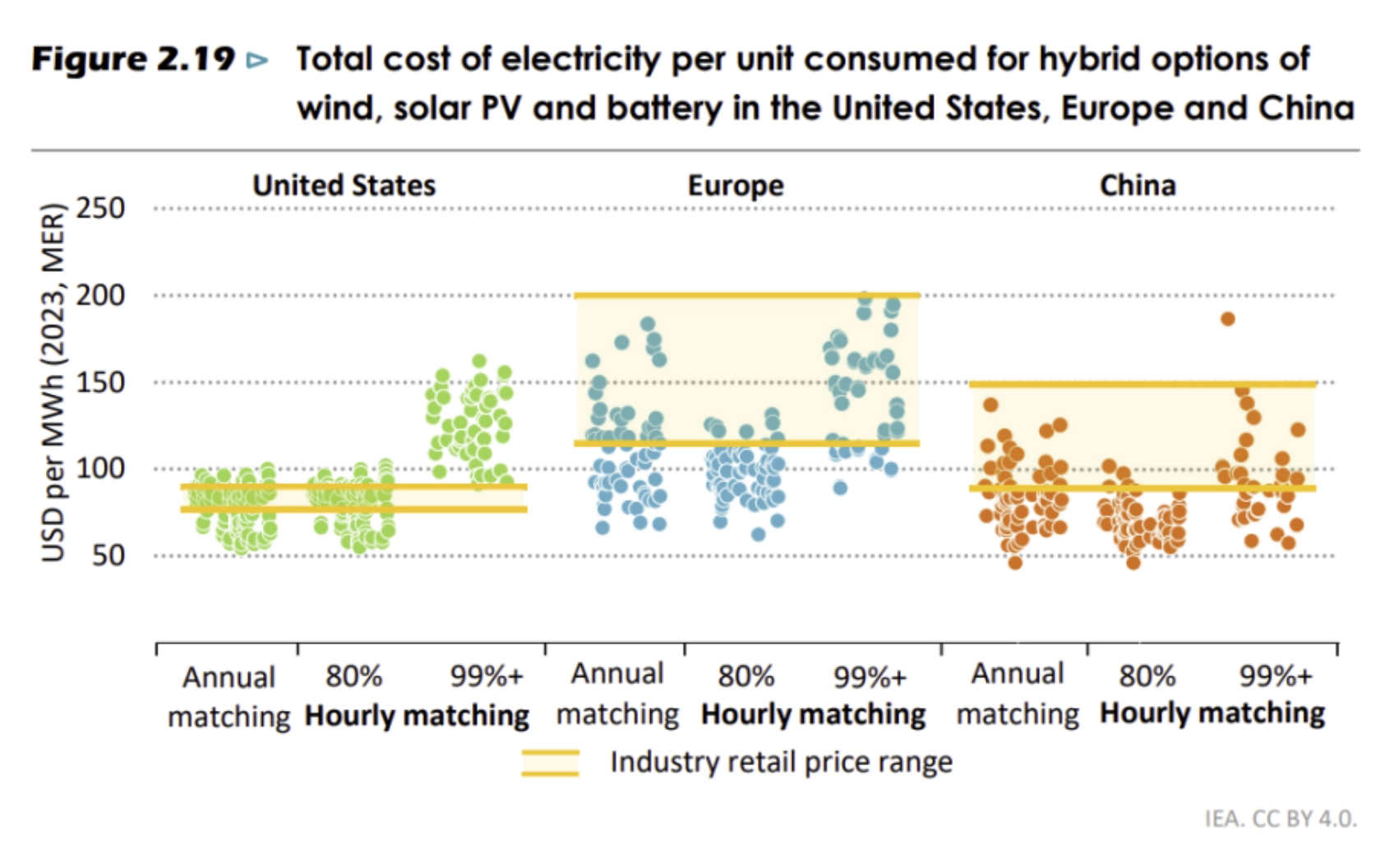
Getting close to 100% hourly coverage is expensive today: issuing bodies do not yet produce hourly certificates; and the scarcest hours, when system demand is high or renewable supply is low, might carry a premium because every buyer wants them. However, this is not a cost most buyers should be pricing yet, because no one is being asked to reach 100% today. The cost of delivering firm, round-the-clock renewable power – combining solar, wind and storage – has gone down significantly as technology costs decline (IRENA report) and is expected to reduce further.
Why some sources quote very large premiums for 24/7 CFE
You may see claims such as:
- ‘Achieving 100% hourly matching can be more expensive than annual matching, with some analyses indicating a 600% average cost premium.’
- ‘Reaching 100% hourly matching can be 200% to 1,200% more expensive than traditional annual matching.’
These figures may be directionally true in some models. The issue is that people often repeat the headline numbers, but leave out what the model assumed about targets, buyer behaviour, and available supply.
In most cases, the model jumps straight to near-perfect coverage without optimisation. It assumes the buyer cannot raise coverage in steps (for example, by improving the wind/solar mix or choosing a more shaped product) and instead must solve the final few percent early — which is where flexibility becomes the binding constraint.
A second issue is that some studies treat supply availability and the investment in flexibility solutions as static. In reality, the cost of flexibility is moving fast – BloombergNEF reports that battery pack prices were 45% lower in 2025 than 2024. IRENA's 2026 analysis goes further: the firm, round-the-clock cost of solar-plus-storage has fallen from above USD 100/MWh in 2020 to around USD 54–82/MWh by 2025 in strong solar and wind regions, with a further drop of roughly 30% projected by 2030 and around 40% by 2035 (scenario-based estimates).
So planning for high hourly coverage looks expensive at today's prices, but those prices have dropped sharply and are expected to keep falling. A premium built on a 100% end state, today's costs, and no phased path in between tells you very little about what the same goal will cost when it actually matters. That is a reason to start measuring your position now, not a reason to be put off.
This is why a single “premium” number is rarely a good guide for a buyer’s decision – especially when it is based on a 100% end state, today’s prices, and no phased path in between.
2. Implementation: what you need for hourly accounting and GHGP Scope 2 readiness
When buyers ask what it will cost to prepare for the GHG Protocol Scope 2 update, the answer is mostly operational. For most organisations, the main cost is internal time. Implementation cost comes from three things: data access, reconciliation, and assurance.
1) Data access
You need two inputs:
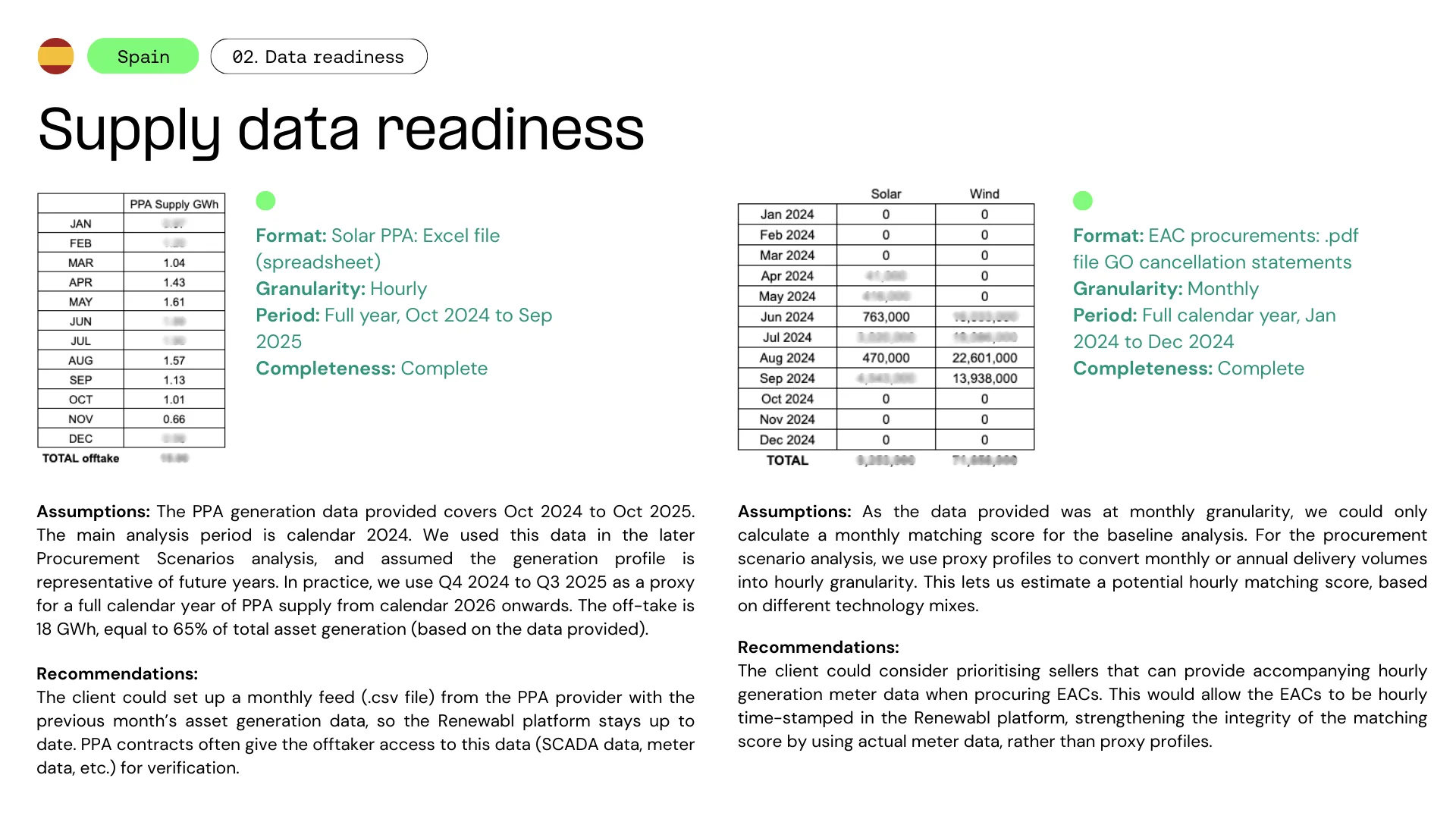
- Hourly demand data for your sites (from smart/interval meters where possible, or from suppliers, data hubs, and energy management systems).
- Hourly supply data for your clean procurement (PPA generation profiles are usually available; certificate profiles vary depending on traceability and what the registry or intermediary can provide).
The effort here is rarely “getting one file”. It is getting consistent data across countries, suppliers, and formats.
2) Reconciliation
Once you have the inputs, you need to line them up hour by hour so the numbers mean something:
- align time zones and daylight saving shifts
- map each site to the right market boundary
- allocate contracted volumes and certificates to the right hours
- calculate your baseline hourly score and the gap by hour
This is the part that usually absorbs most personhours, especially in the first reporting cycle.
3) Assurance and repeatability
If the output will go to auditors, customers, or a board pack, you need controls:
- consistent rules across teams and countries
- versioning and an evidence trail
- a process you can repeat monthly, not rebuild each time
A spreadsheet can work for a pilot but it may become hard to govern at scale.
Where a platform helps
A platform reduces manual effort and improves consistency. For example, Renewabl Track pulls demand, contracts, and certificates into one place, then calculates annual, monthly, and hourly matching metrics with a clear audit trail. That matters because it turns implementation from a one-off project into an automated process.
3. Market exposure: how hourly matching supports ROI on PPA procurement
PPA deals often run for 5–20 years, and it can take months to structure, approve, and sign them. PPAs are one of the biggest levers buyers have for managing Scope 2 and energy cost risk, simultaneously.
A hedge only works in the hours when supply shows up
A price hedge is straightforward in principle: you buy (or sell) the required volume at a fixed price, to protect against adverse market pricing.
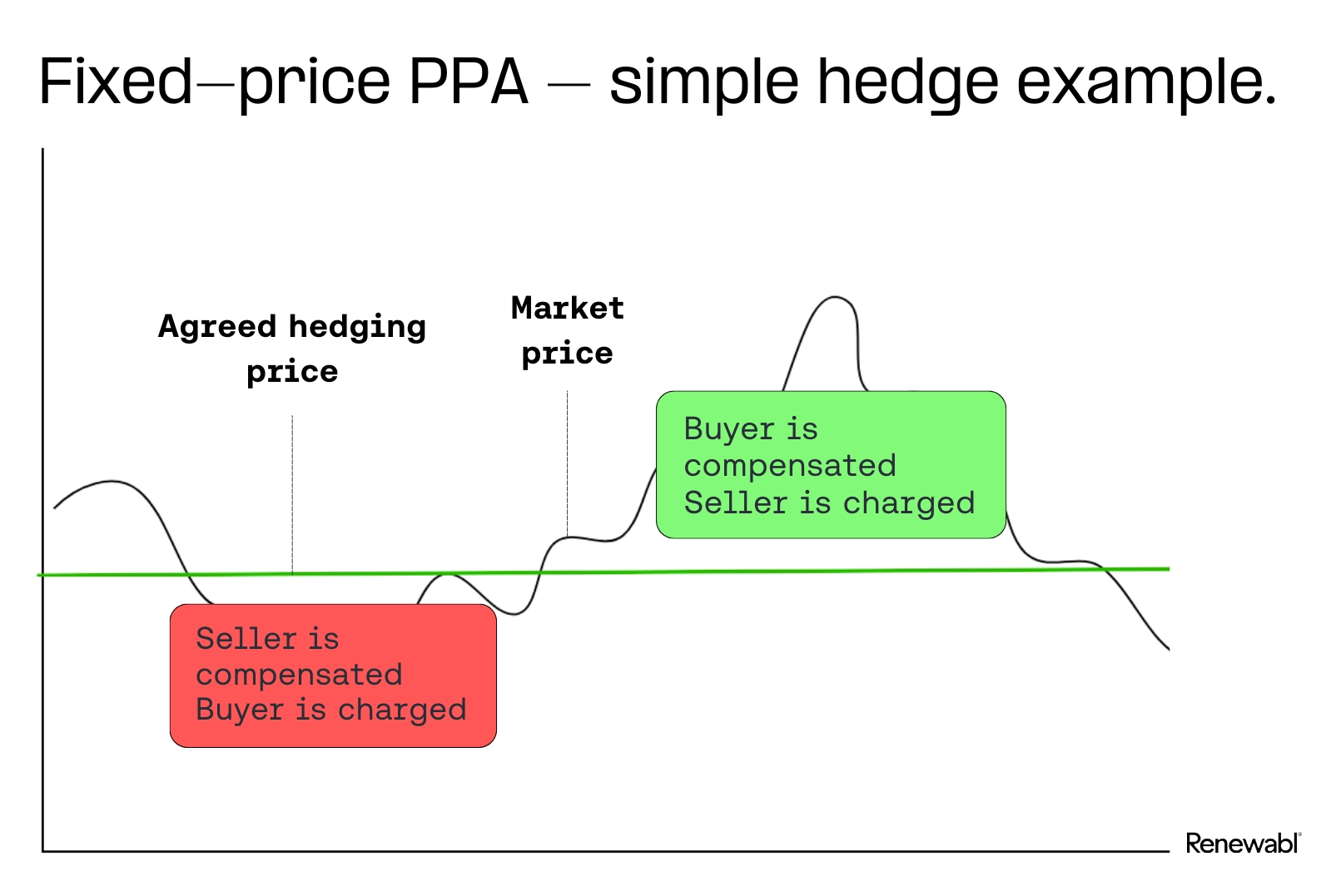
“A hedge like a PPA is a straightforward concept. You lock in a price. The aim isn’t to earn money – it’s to give you confidence in what you’re going to pay, so the outcome should be predictable cost.”
– Carolyn Addy, Renewabl
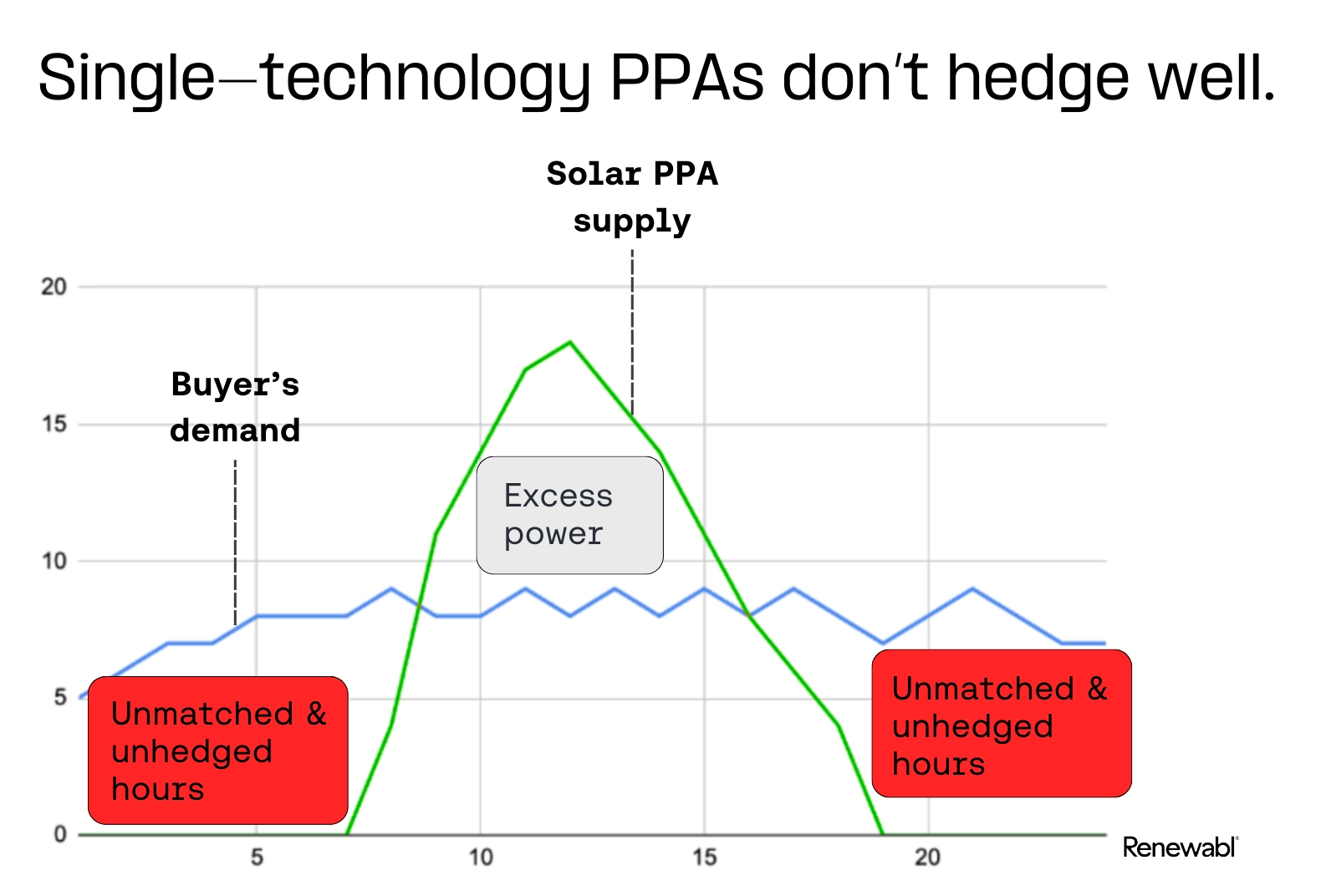
When buyers value a Power Purchase Agreement, they often value the full contracted volume as if it hedges the full demand position. In reality, since electricity prices settle hourly, only the hours where PPA generation overlaps with your load are “hedged hours”. With a solar-shaped contract, that tends to be the middle of the day.
In the remaining hours, two things happen:
- Shortfall hours: you still need electricity, so you buy it at the market price.
- Excess hours: you have more contracted volume than you need, so it is effectively sold back at the market price (or in some structures, settled financially against the prevailing market price).
Those shortfall and excess volumes are not “hedged”. They behave like open market positions. In other words, part of what you thought was a hedge becomes a bet on where prices will land.
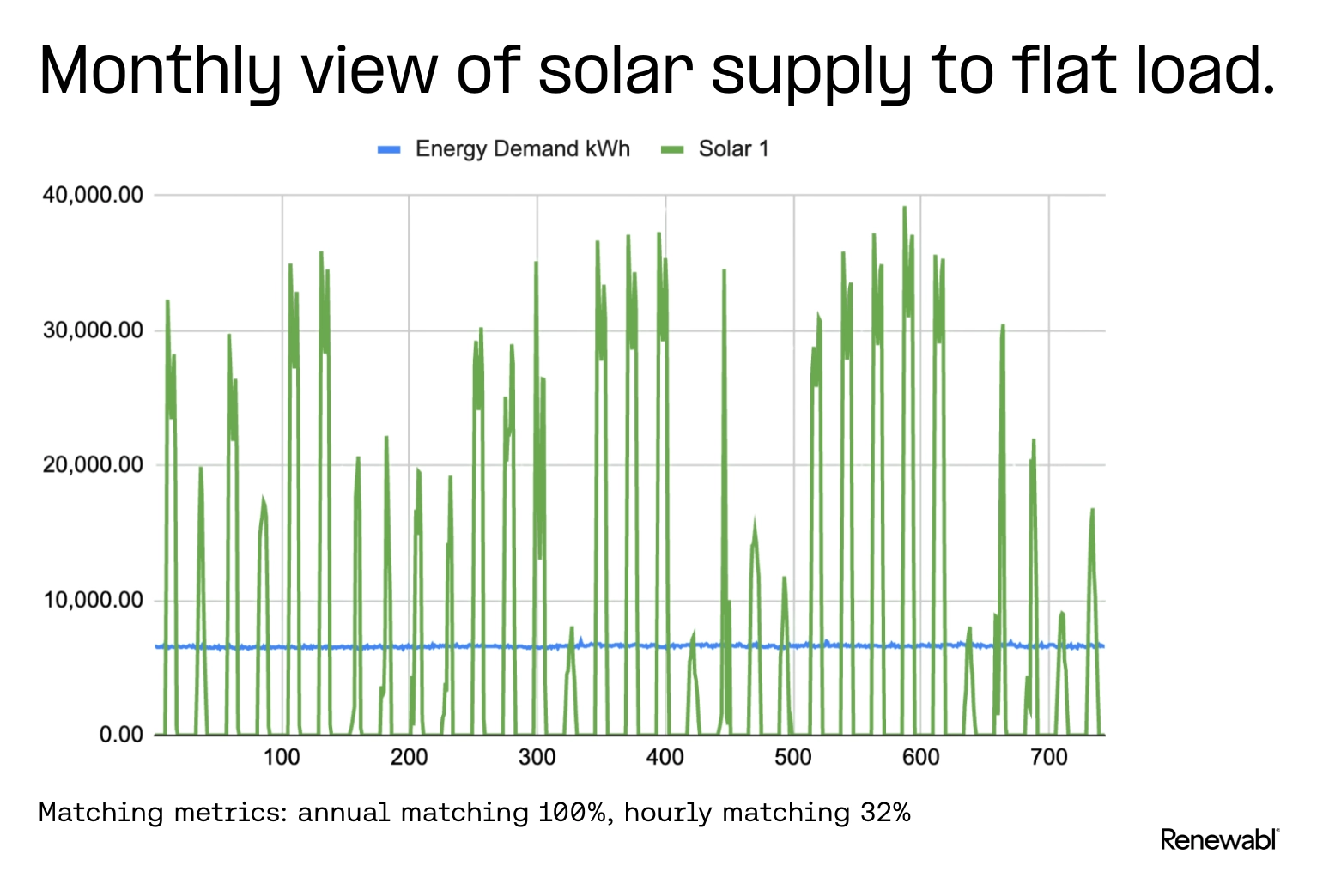
The issue gets worse when considered over a longer period of time. In the below example,
- The hedge is only effective in hours when the solar plant generates.
- When solar does not generate, there is no contracted volume, so there is no hedge in place for those hours.
- In those hours, the buyer must buy electricity from the spot market at the prevailing price.
- The lower the hedge effectiveness (the match between hourly demand and hourly supply), the more exposure the buyer has to market-priced volumes.
- The objective of a hedge is to reduce, or ideally eliminate, exposure to price volatility.

For a fuller explanation of how to read a contract's real hedge, see our article: Does your PPA actually hedge?
Hourly matching is a proxy for hedge coverage
Hourly matching effectiveness measures the hour-by-hour overlap between your load and your contracted clean supply. That same overlap is also a practical proxy for how much of your demand is truly hedged.
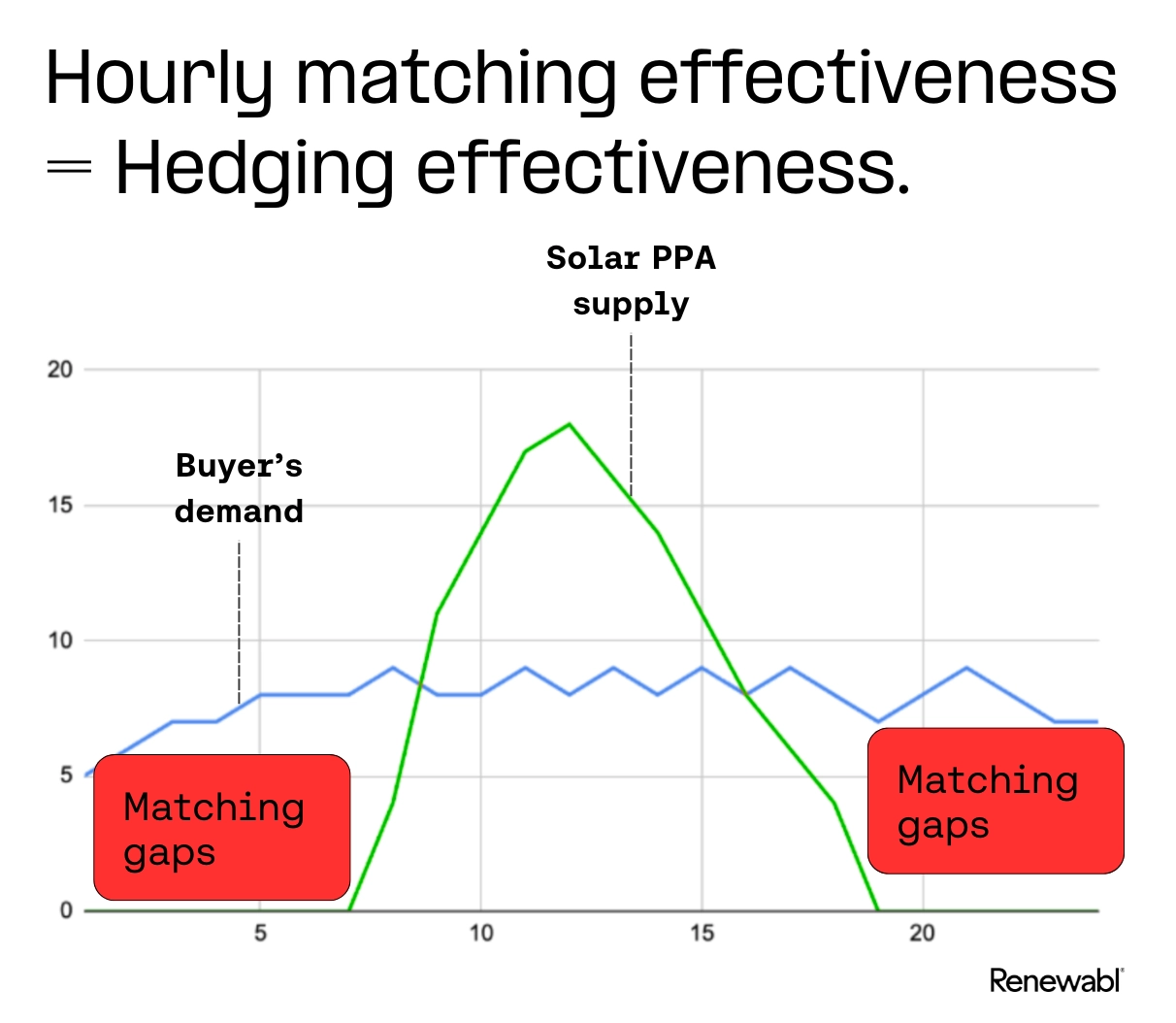
A simple rule of thumb helps teams communicate the concept:
If you are 80% hourly matched over a period through a bundled product such as a PPA, you are hedged for 80% of your volume over that period.
Two clarifiers avoid common confusion:
- A hedge is not a profit strategy. The goal is not “make money on the PPA”. The goal is reduce adverse price swings and improve budget certainty.
- Volume share is not the same as cash exposure. Volume share is not the same as cash exposure. You might be unhedged for only 20% of your volume, but if those uncovered hours fall in high-price periods, that 20% can represent a much larger share of your total spend.
For more examples and a step-by-step explanation, watch our webinar with Enery:
The buyer question to ask: what is our cash at risk?
This is where the ROI story becomes concrete. A useful way to frame it internally is:
- Hedged cash: the part of your expected spend that is protected by contracted supply in the same hours.
- Cash at risk: the part that is still exposed to hourly spot prices because of under-coverage or over-coverage.
Many organisations do not quantify this today. They sign a PPA, report the annual volume, and file the hourly mismatch away. But once you run the position hour by hour, it is common to find that the “cash at risk” is bigger than expected – and, in some portfolios, bigger than the truly hedged portion.
The goal is to reverse that relationship. You want more cash in the hedged bucket than in the risk bucket. Better hourly matching is one of the clearest signals that you are moving in the right direction.
Other misconceptions that may lead to wrong 24/7 CFE estimates
When teams estimate the cost of hourly matched procurement, a few common assumptions can either overstate the premium or understate the work needed to improve an hourly CFE score.
1) “Only PPAs can improve my hourly matching score.”
Unbundled Energy Attribute Certificates (REGOs / GOs) can also help raise an hourly matching score, especially for energy buyers who do not have the volume, credit requirements, or internal capacity to sign a PPA yet. The trap is treating certificates as a bulk, end-of-year purchase. That often means paying for renewable MWh that do not line up with your shortfall hours, so the score barely moves.
A future-proof approach starts with the baseline. First, identify which hours drive the gap, and which market boundary applies. Then choose the technology and location that best fits your shortfall. From there, focus on certificate allocation by hour – for example allocating Guarantees of Origin by hour where the evidence allows. Where it does not, be clear about what has been proxied.
“Where registries do not yet issue fully granular certificates, Renewabl can still reconcile procurement to demand hour by hour and keep a clear record of what is based on metered data versus what uses proxy profiles.”
– JP Cerda, CEO at Renewabl
2) “If I’m on a green tariff, I’m automatically on 100% 24/7 CFE.”
A green tariff can support an annual renewable claim, but many tariffs do not evidence matching at an hourly resolution. Buyers should not assume that “100% renewable” means “no remaining uncovered hours”. If a tariff is part of your procurement plans, it is worth checking what matching evidence is provided, and at what time resolution. Independent initiatives such as Matched Energy help analyse how “clean” common UK supply tariffs are in practice.
3) “My grid is already renewable, so the cost should be close to zero.”
Operating in a relatively renewable grid does not automatically translate into claimable 24/7 carbon-free electricity. The default grid mix cannot simply be treated as your contracted supply: certificates for that generation may already be cancelled by other buyers, and without clear allocation, multiple organisations can end up making overlapping claims on paper. When that happens, corporate claims stop signalling real demand for new clean supply in the hours that are still fossil-heavy.
That is why credible 24/7 CFE progress still depends on what can be evidenced through procurement and data – even in markets with high renewable penetration.
Conclusion: what is hourly matching going to cost me?
In 2026, the most useful way to answer “what will hourly matching cost?” is to stop looking for one headline premium and start with the organisation’s real position. With GHGP Scope 2 planned updates, energy buyers are not being asked to jump to 100% 24 7 carbon free energy overnight. The near-term work is to get ready for credible reporting, and to make better procurement decisions with hourly data. That means separating three costs: (1) the price premium for better electricity matching in the hours that matter, (2) the operational cost of getting demand and supply data into a repeatable process, and (3) the “hidden” cost of being exposed in uncovered hours when markets settle hourly and volatility hits.
“Hourly matching effectiveness also means hedging effectiveness. Better hourly matching, or a stronger 24/7 score, means fewer unhedged hours, less exposure to volatile spot markets, and more predictable cost outcomes.”
– Carolyn Addy, Renewabl
A practical 2026 approach is phased and manageable. Build visibility first: pull in interval demand data, obtain generation data where possible, and reconcile supply and demand hour by hour to establish a baseline. Where hourly profiles for certificates are limited, proxy profiles can still help stress-test what your CFE position could look like under different mixes. Then use that baseline to score procurement options on both sustainability and risk, and quantify “cash at risk” in peak-priced uncovered hours. For many buyers the realistic near-term move may be from annual to monthly matching, with hourly as the direction of travel rather than a target to hit now.
For teams that want to move faster with less internal lift, Renewabl’s Digital Advisory supports this end to end, including country pilots to translate hourly results into a realistic view of effort and potential premiums.


.webp)

