

In this recent interview with Ariana Hurtado at Offshore magazine, Renewabl CEO JP Cerda explains how hourly matching is changing procurement strategies for offshore wind developers – from curtailment risk to storage coordination.
Key highlights
- Hourly procurement provides clearer price signals and more stable revenues by aligning contracts with actual energy output, reducing risks and encouraging investment.
- Granular data enables better storage coordination, reduces curtailment and enhances the accuracy of renewable energy claims, especially as new standards like the GHG Protocol evolve.
- Operational challenges in offshore wind include transmission risks, project delivery uncertainties and grid congestion, which can be mitigated through detailed hourly data analysis.
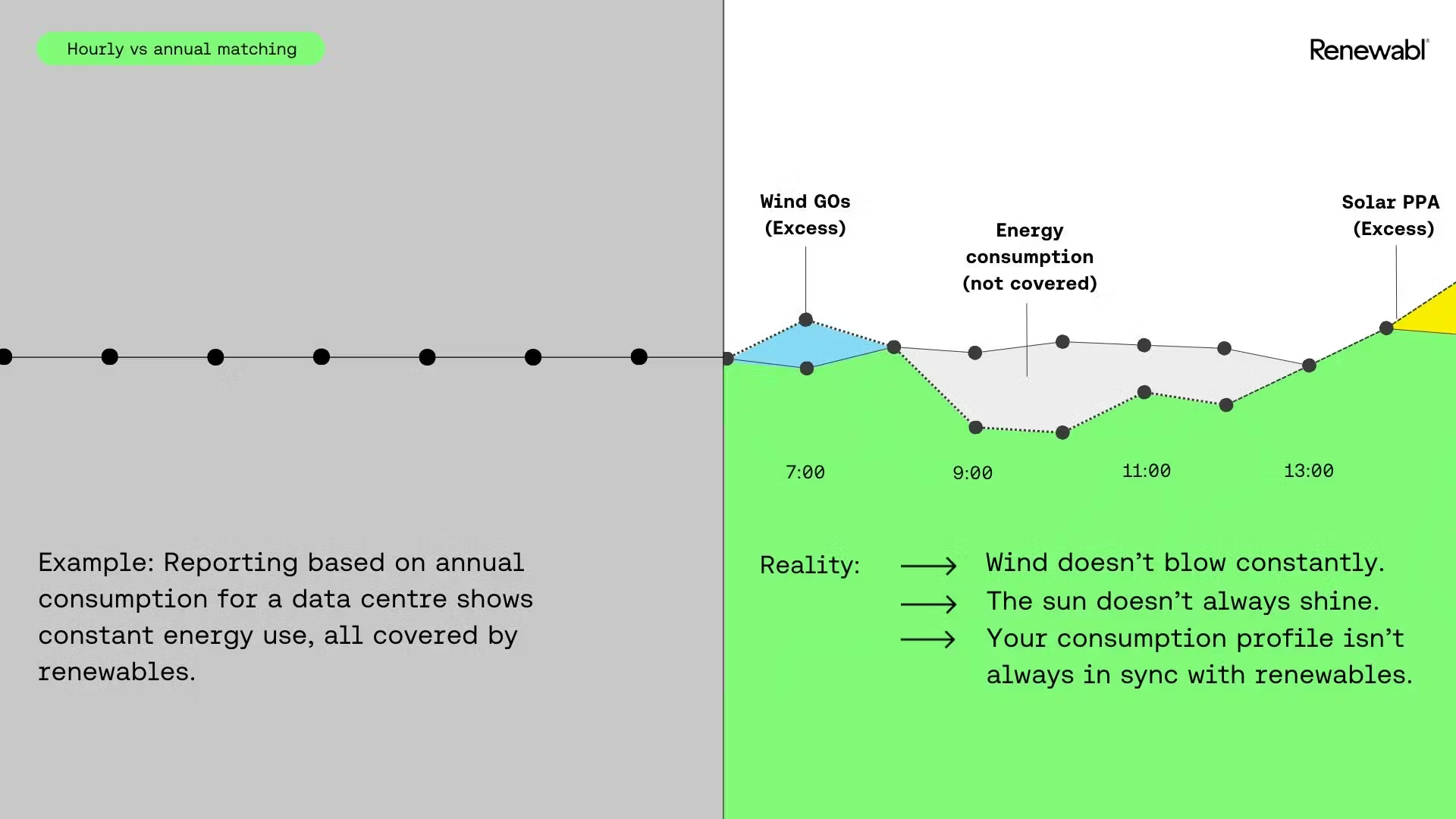
As corporate buyers push toward 24/7 carbon-free energy, offshore wind developers face a new challenge of proving clean power delivery hour by hour.
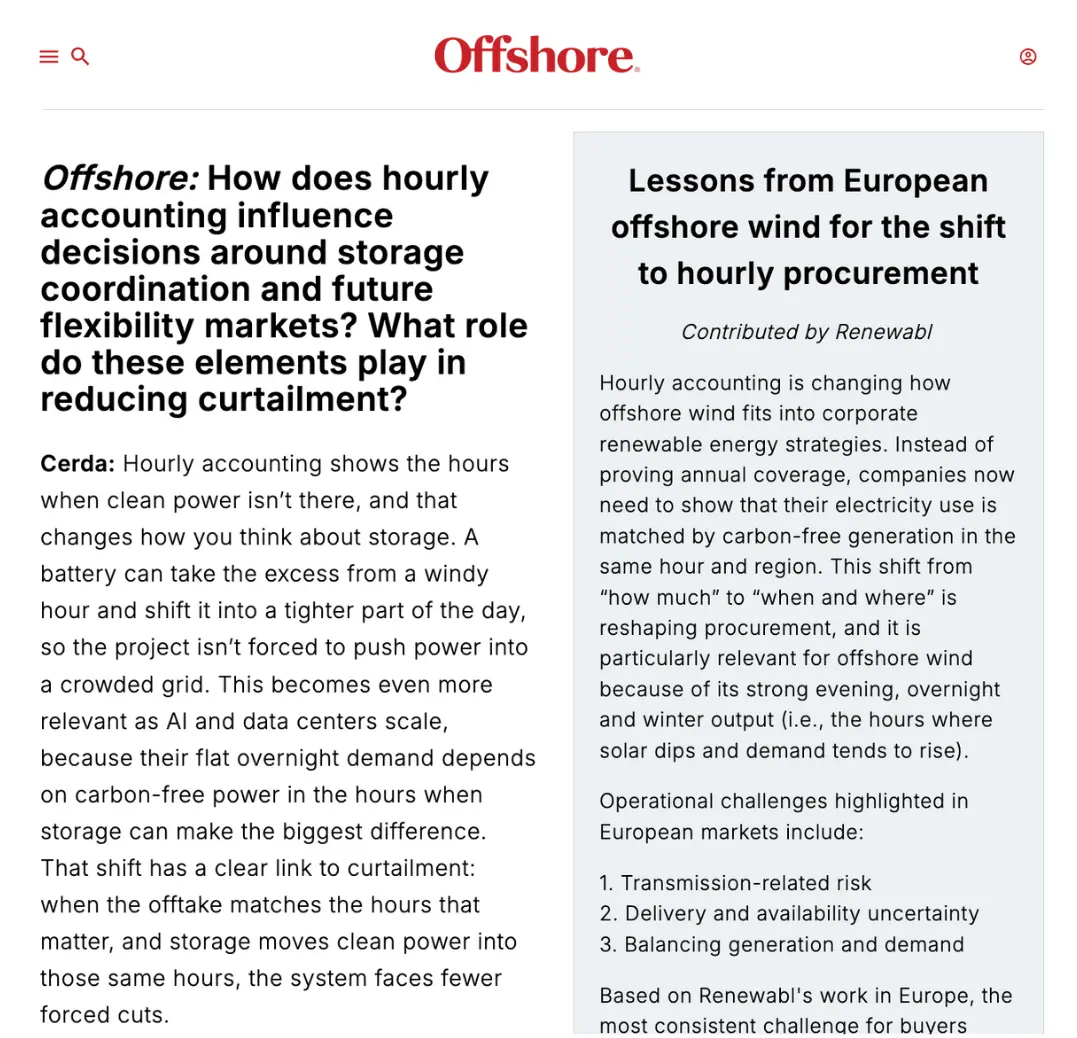
In this exclusive Q&A interview, Renewabl CEO and Co-founder Juan Pablo (JP) Cerda explains why granular data and hourly procurement models are reshaping project economics, risk profiles and the future of offshore wind.
Founded in 2023, the London-based renewable energy technology startup enables corporate buyers to track, procure and report on hourly matched clean energy.
The company also recently announced that it is partnering with S&P Global on the development of an "Hourly EAC Index," which will provide a fair-value reference point for the certificates tied to scarce-generation hours for offshore wind developers.
Cerda has more than 20 years of experience in the energy sector, from trading to technology, having previously served in various roles with bp, Shell, Schneider Electric and Zeigo. In the article, he discusses the operational and market challenges offshore wind developers face when implementing hourly procurement models.
.webp)

