

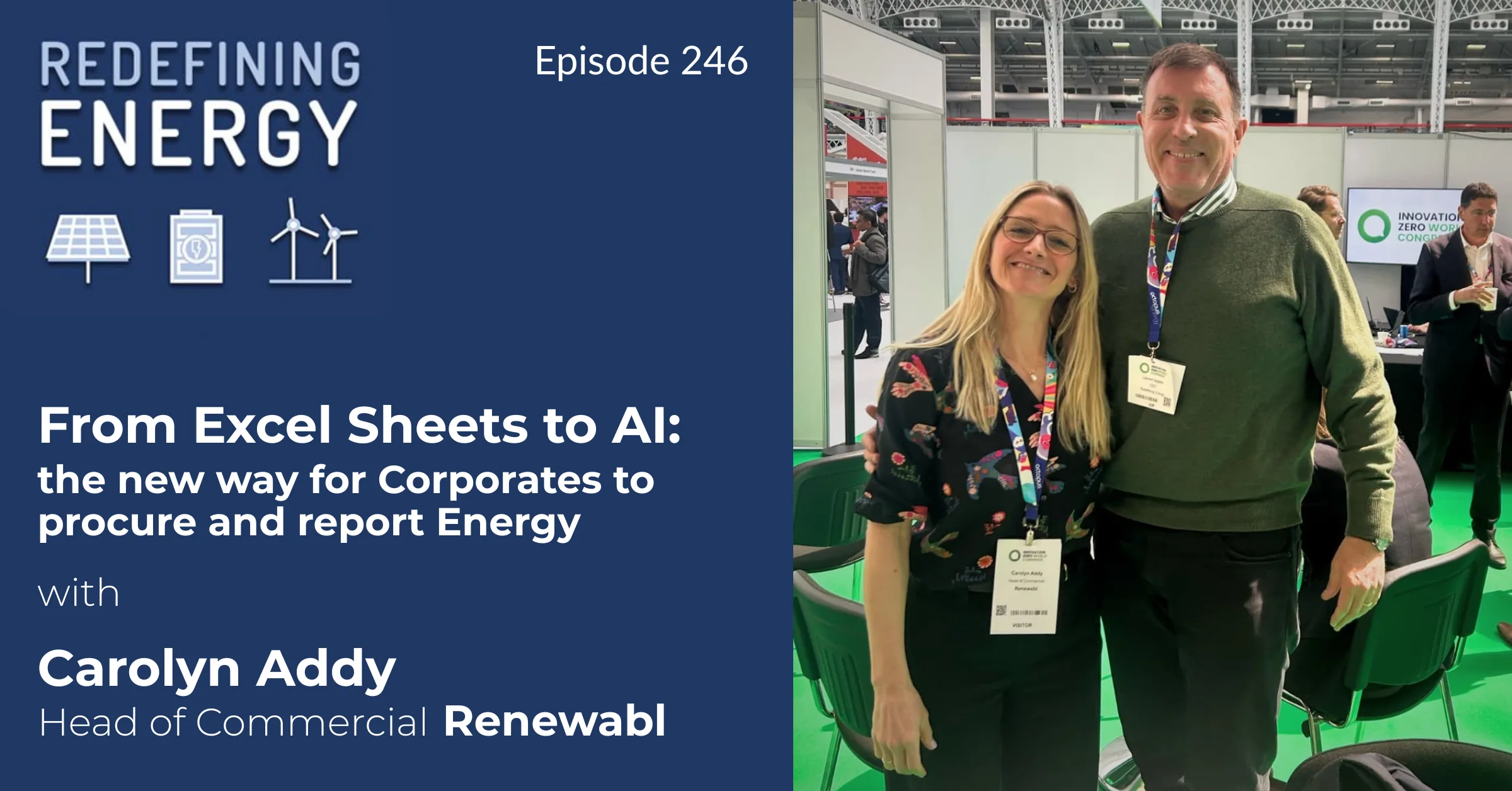
We were delighted to join Laurent Segalen and Gerard Reid on Redefining Energy for a lively discussion about how companies buy and report renewable energy in 2026.
Our Head of Commercial, Carolyn Addy, spoke about the work behind those decisions: bringing scattered data together, understanding what existing contracts deliver, and preparing for hourly accounting while the rules evolve. Her starting point is practical: get a clear picture of where you stand today.
There’s plenty of debate along the way, from spreadsheet overload to the claims behind corporate climate targets. Listen to the episode or read the interview below.
This interview transcript has been edited for length and clarity. Square brackets mark editorial clarifications; […] marks omissions within an answer.
Why energy buyers need better data
Laurent: Carolyn, welcome to the show.
Carolyn: Thank you for having me.
Gerard: Carolyn, it's great having you, for a start. And maybe I'll just kick off by just sort of asking a little bit about the state of the market for energy procurement. What's going on there? And, you know, what are the trends you're seeing?
Carolyn: If we think about it from a corporate energy buyer's perspective, one of the big trends we see is a significant amount of time spent managing the admin and the data flows, and a real will to move to diminishing that time and much more on higher-level strategic decision-making, in what is an increasingly complex procurement and regulatory market. So buyers are looking for better tools to enable decision-making.
“I think energy buying is already a very complex job, often run by small teams, for even very large corporates.”
– Carolyn Addy, Renewabl
Gerard: I thought it was very interesting, the way you answered that question, because you didn't talk about energy procurement – you talked about all the administration that they're focused on. Maybe explain what that administration burden is, because they're going, "Oh, you're just buying energy, that's not too difficult, is it?"
Carolyn: So if we think about large corporates – thousands of sites, data spread across countries, multiple Scope 2 levers, so PPAs, unbundled EACs, potentially some on-site generation, green tariffs – collating all of that data, and there's a mix of access to that data, whether you can get access to your consumption data, whether you can get your contract data all in one place.
You need all of that collated in order to have the correct foundation to make your longer-term procurement decisions. And potentially, where you have a relatively simple portfolio and maybe a single solution, maybe it's easier. But for large, complex portfolios and multiple market levers, it becomes increasingly complex to manage that, and also to have visibility of how those solutions are performing.
That's from the procurement side. That then also flows through to sustainability teams, who are using that same data to do their internal sustainability reporting, or all the different frameworks they're reporting to.
Where reporting standards are heading: SBTi and GHG Protocol
Laurent: So you introduced Scope 2 – which is, for people who don't know, the emissions embedded in the electricity you buy. That's been around for 25-plus years, and I know, because I was part of the first team who coined that term together. But of course, along the way, there's been a lot of commitment – "we're going to be green," and so on.
And what we realised is that, in fact, the claims were not really aligned with the reality. The reality is electrons are traded on an hourly basis, and the people would report on an annual basis. So you would basically use solar power in August to say that you were consuming power in December. And that's kind of the end of the road. But still, you have those commitments to be net zero. So explain a bit how now those two things are clashing one against the other.
Carolyn: The current framework, where most corporates are basing their renewables claims on annual matching, which is broadly matching your renewable energy claim within 12 months of the consumption and production. So – saying the certificates, which is the evidence for most renewables claims, if they were generated from within the same market boundary as your consumption, then you can use that. That was a framework which suited the time when we were trying to extend renewable procurement. We were trying to make it easy for corporates to set and reach targets. They were having internal stakeholder discussions about the solutions they would use, etc. It suited the time. It doesn't really reflect the reality of how the energy system works.

Carolyn (continued): Most energy procurement is notional, to some degree. So, except where you have on-site generation or you have a direct wire, energy is going into the grid you're drawing, and a renewable energy claim is always based on a notional claim. You can't say that, in most cases, energy is coming directly from a renewable asset. But even within that, there is now this understanding, increasingly, that making a claim – as you say, for example, that your German consumption in the middle of the day in winter is covered by solar production in Spain – doesn't make any sense.
Also – is it helping the energy transition? If we're trying to get to a diversified, flexible grid, where different renewable sources can be turned off and on to make a balanced, secure grid, this kind of structure arguably doesn't provide the right market incentives.
Gerard: What's the alternative?
Carolyn: The direction of travel is towards more granular accounting of renewables procurement. So, looking at deliverability, so that consumption and production should match. There are existing market boundaries, but the discussions under the protocol update and SBTi, et cetera, would potentially tighten what those markets look like. That's the geographical matching. And then there's the temporal matching – matching hour by hour, so that consumption and production match in those times as well. That's really trying to bring the physical generation of the electricity closer to the consumption that is being claimed to be covered by that renewable.
"When we talk to corporates about how they're looking at this change, and what's going to be required of them, there is a lot of anxiety."
– Carolyn Addy, Renewabl
Gerard: And can I ask, is this a movement in Europe? Is it a global movement? Where are we seeing this happen, and where not?
Carolyn: It's a global movement. In Europe, we're certainly probably at the forefront of this. So the GHG Protocol is moving towards this – [a consolidated public consultation is planned for Q2 2027], and moving towards this way. Likewise SBTi, CBAM, CSRD. The direction of travel seems to be pretty agreed upon; exactly how, and with what potential interim feasibility measures, is definitely up for discussion. There's for sure some resistance, particularly around the pressure being put on corporates to move towards what is, unarguably, going to be more work and some added complexity. So that is very much under discussion at the moment. But the current kind of annual-matching picture is probably out of date – that's fairly well agreed.
Getting started with hourly accounting
Laurent: Okay, so Carolyn, you're very prudent, and I can understand that – you've got clients. Me, I could not care less. So the reality is you have two camps, and it's mostly big tech. You have camps who say, "Okay, hourly matching, we know how to do it, we can do it" – of course, we're not going to be 100% hourly matched. And others […] they have those big ESG commitments.
So I'm wondering – those ESG departments, they are as useless as the... sorry to say that, but the testicles of the Pope. Why do they want to continue to claim they are net zero, when the emissions are going to triple, and maintain the fiction through accounting tricks that they are good for the climate? That, for me, is a bit of a mystery. And when you have a budget of 100 billion a year to build data centres, I don't think that reporting by the hour is going to make them bankrupt.
Okay, so that's my rant. Let's go to a question. So the question is, basically: you have two camps. You have the one who want to compute the CO2 – and I don't know how they want to do it – and the other, they want to go towards more hourly tracking, and so on. And at the end of the day, the proof is going to be in the pudding, which means some guys are going to report by the hour, or start going towards that, and the others, they're going to spend more on PR than anything. So explain a bit how the development of the initial hourly matching, or at least hourly tracking, looks.
Carolyn: Really, what you need to do in order to get an hourly matching picture – and this is one of the things we talk to clients a lot about – is that the start is not reaching any particular level of matching. It's doing the accounting.
So it's starting to get your data in place, having some kind of tool in which to store it, and getting a picture of how closely your consumption and production are aligned. That is the first step. And when we talk to corporates about how they're looking at this change, and what's going to be required of them, there is a lot of anxiety – and I really understand why.
I think energy buying is already a very complex job, often run by small teams, for even very large corporates. What we have seen is that once you start getting into the data, and you start getting a picture of where you do have visibility and where you don't, you start putting in place solutions to source better data. And then you can start building up a picture of, okay, what does my hourly matching picture look like? And then, are there easy ways to improve that?
So we've done a number of studies with clients where, even before you start looking at sourcing specifically hourly-matched products, by making particular technology choice you can quite significantly increase your hourly matching score. And then start building up a roadmap to look at how you might transition towards procurement from an hourly lens.
“By choosing a particular technology, you can quite significantly increase your hourly matching score.”
– Carolyn Addy
And that piece of work also supports most of what other energy managers are doing anyway – so actually, better visibility of that data also supports better decision-making on PPA procurement. It gives you better data to work with when you're doing annual unbundled EAC purchasing, etc. So that kind of data foundation supports a number of different initiatives, and, as I mentioned earlier, also across sustainability and procurement.
Laurent: Yeah, and the problem is, right now, everything's pretty much managed on Excel sheets. That's tough.
Carolyn: We have seen some incredibly complex, sophisticated Excel sheets, trying to manage existing procurement – for example, very sophisticated allocation engines, etc. Spreadsheets can do a job to a certain point, but obviously you get things like broken links, you get human error in there. It does get to a point where it outlives its usefulness.
So we talk to a lot of companies who are looking for a better solution. One of the things we keep hearing is how much of their internal team's time is spent collecting this data, analysing it, trying to understand it, to then be making what are, more, frankly, important and strategic decisions. Once you add in looking at data from an hourly lens, and you have thousands more data points for every site that you're already managing, and needing to do that level of matching – I think, really, that does become unmanageable.
We have seen some incredibly complex, sophisticated Excel sheets.
– Carolyn Addy, Renewabl
Why some companies are moving ahead
Gerard: I'd like to go back to Laurent's little rant there on greenwashing. I'd love to get your sense of the way you think companies are looking at the future here. I'll be honest and say – I think net zero is dead, okay, and I'm not going to even talk about it. I'm wondering what's the view of corporates that are out there? What do they look at when they're looking into the future? How do they see things?
"It's the front runners that are setting the pace."
– Carolyn Addy, Renewabl
Carolyn: I can't tell you how they're all looking to the future, but I can talk about some examples. As usual, it's the front runners that are setting the pace. And these are corporates who can see the direction of travel, and who are used to being climate leaders, and are looking at how they will make the transition.
For example, you've got a subgroup of RE100 who have joined the 24/7 coalition, and Unilever is the most recent member to sign up to that. And what we're seeing from them is that being on the front foot of this change isn't just about compliance – they're actually seeing this as a competitive advantage, and part of their brand around climate leadership. As well as the climate leadership angle, they're also seeing advantage in terms of better hedge contracts, cleaner compliance, and less time spent firefighting internally, and more time spent on long-term strategy.
And these companies are actively looking for solutions that support that – better platforms, better data, and using AI carefully as well, which helps them manage what is an ever-increasingly complex procurement and regulatory landscape.
The debate over data centres and reporting rules
Laurent: Well, look – there are more and more governments now, especially with the development of data centres. They say, "Look, you need to bring your own power, and by the way, it needs to be 80% renewables." We've seen that in Spain recently.
So they're waiting, but the government is going to catch up with them – because okay, maybe in Texas you can still put seven gigawatts of gas, but anywhere else... okay, you go to the north of Scandinavia, that's all great, but the amount of hydro is limited. So at some point you need to play the game if you really want to expand your energy consumption.
More governments say, "Look, you need to bring your own power, and by the way, it needs to be 80% renewables."
– Laurent Segalen, Redefining Energy
Laurent (continued): Do you feel that the governments are getting a bit nervous, that corporates who used to define the rules are now kind of stuck in a PR battle, very American-style? Because, "Okay, what about your rules?" "Oh yeah, they're still under revision, under comment." The first Greenhouse Gas Protocol, we got it out in six months, and that was done. And now it's an exercise – it's going to take five years to put it together. And I know we kind of see the direction of travel. So what's happening?
Carolyn: You mentioned the Spanish government – they are considering setting a requirement on data centres [with a grid-access capacity of at least one megawatt] to cover at least 80% of their energy with renewables, accounted for hour by hour. You're right, I think governments are seeing a lot of a PR battle going on, and that is one of the frustrating things.
So there is a lot of resource going into the PR battle that could potentially be better used in actually pushing forward on energy procurement, and looking at how businesses can create the most impact, given the weight they have behind them.
Building a procurement roadmap
Laurent: [...] Let's go back to the type of service you do. Your guys say, "Okay, I've got a wonderful Excel sheet, but it's finished – hours, I'm done." What do you propose?
“So we're moving from a kind of theoretical picture to a much more practical, implementable system.”
– Carolyn Addy
Carolyn: We would help clients get a picture – get all their demand, all their sites, their whole portfolio, get all of their consumption data in one place, get all of their existing contracts. That gives you a really clear picture of your current demand and supply. Energy procurement and sustainability teams need that anyway. That gives you a really good springboard for building your procurement roadmap.
What we do is provide a really flexible system: when the data is on our platform, you can look at it from an annual lens, which is how most corporates are still buying, and then you can also look at it monthly, and you can look at it hourly.
What this means is that corporates don't have to see this as a switch they're going to flip at some point – it will be a journey. Some corporates are also looking at a kind of halfway house, where they look to strict monthly matching before they move to hourly matching. But until you've really got visibility of what your current demand and supply picture looks like, you've really got no idea how you're going to move towards more granular accounting.
The other piece is that we see a strong correlation between hourly matching and hedge effectiveness – and this is an interesting part, where it really brings sustainability and procurement teams together. If you look at a well-hedged PPA, you are eliminating a lot of risk from that procurement. And our team did a review of a thousand scenarios, looking at blended technology PPAs in-country, right up to cross-border PPAs and unbundled EACs.
Carolyn (continued): What I think was really helpful in that analysis is that we saw, in normal years, price didn't vary that much – but in the bad year, the well-balanced technology-mix PPAs eliminated a significant amount of risk compared to the other solutions. And so, bringing in more of a risk-management way of considering hourly matching, and the correlation with hedge effectiveness, helps the argument for moving towards more granular accounting.
Connecting tracking, procurement and advisory
Laurent: Carolyn, beyond a very sophisticated renewable tracking system, what other services does Renewabl provide?
Carolyn: Beyond the tracking piece, there's really two other main parts of what we do. So the first is Renewabl Trade, which is the procurement part of the platform, and it's a really powerful sourcing engine where users can run super-efficient PPA tenders out to our network of sellers. The NPV and cash-flow analysis is done automatically in the system, alongside an assessment of hourly matching, which, as we talked about earlier, is a great proxy for hedge effectiveness.
And this means buyers feel much better informed during sourcing processes, and it can help mitigate some of the challenges companies are facing when, for example, they're dealing with the impact of negative European solar prices in their PPAs.
Trade also gives buyers a really easy way to run competitive tenders for unbundled EACs, and they can sign an agreement knowing they've properly tested the market. It's a really flexible system, where users can ask for exactly what they're looking for, and sellers can define offers to create the most value for the buyers – so, for example, in bundled pricing.
And then the other part is Digital Advisory – that's where we overlay our expertise on top of the technology we're providing, and help teams work out where they actually stand today in terms of their renewables procurement. So, looking at a data-readiness assessment, and what their hedging and compliance exposure looks like, and then into what the practical next steps are to future-proof their procurement.
And then, on AI – we're actively building that into the platform now, to help teams handle the complexity, spot issues earlier, and spend less time on the admin that we were talking about. Really, it's renewable energy tracking, advisory and trading, all sitting on the same data, and using AI increasingly, where it helps to join it all up.
Laurent: I can see that the sustainability function and the energy procurement function are going to start becoming more and more intertwined. I'm not saying merge, but really getting much closer. The fact of having the tracking and the trading gives you a real competitive advantage – otherwise you're working in silos, where some people report on the right and some people trade on the left. Am I seeing it right?
Carolyn: Yeah, absolutely. And increasingly this becomes a virtuous circle, where you need sustainability to be driving, to some degree, the procurement policies, and then the results of the procurement flowing back into the sustainability reporting. And where you might have done that activity previously – you might do that once a year – now it needs to be continuously done, as markets change, as regulations change, etc. So, increasingly, sustainability and procurement need to be singing from the same hymn sheet.
What comes next for renewable energy procurement?
Gerard: So, Carolyn, maybe as a last question, could you just talk about how you see the future of energy procurement, and also the whole – again – related certificates and all that type of stuff as well?
Carolyn: I'm pretty optimistic here. We can all see where things are heading in terms of greater transparency, and however the various consultations finalise, more granular accounting isn't going away. We also see the government pressure building – the Spanish proposed rule for data centres is one example, and I don't think it will be the last.
What we see is very successful early initiatives around the availability of hourly-matched products, hourly certificate trading initiatives, etc. So we're moving from a kind of theoretical picture to a much more practical, implementable system. And the front runners will test and use that system, and make it much more achievable for the ones who come behind.
Unbundled EACs are potentially going to go through a bit of a rebrand as we move away from annual matching – that system did leave them quite exposed to challenges around how much impact they're really creating. So I think tighter sourcing and use criteria will help there.
What I would say to anyone sitting on the sidelines is that doing nothing isn't actually a neutral choice – it actually means going backwards, relative to everyone else who's moving forward. And this period of uncertainty is actually a really good time to prepare, and that preparatory work has value now, as well as looking into the future.
“Doing nothing isn't actually a neutral choice – it actually means going backwards, relative to everyone else who's moving forward.”
– Carolyn Addy
Laurent: Well, Carolyn, what I get from it is that progress is a bit like tango – you know, two steps forward, one step backward. Thank you so much for working on this, and for being an agent of transformation for more transparency, because the current system doesn't work any more, and the new system is being built through trial and error. But at the end of the day, you need good data.
Gerard: Excellent. Carolyn, thank you very much for coming on the podcast. That was—
Carolyn: Thank you so much for having me.
Gerard: Very interesting.
Laurent: Thank you, Carolyn.


